The Median Price Gap Between Brookside and Waldo Isn't What It Looks Like
October 1, 2026
October 1, 2026
In May 2026, Brookside's median home price fell 20 percent compared with the same month a year earlier. Look at that number alone and it reads like a neighborhood losing steam. It wasn't. In May 2025, twelve Brookside sales cleared a million dollars. The following May, three did. The mix of homes that happened to close changed. The neighborhood did not.
That single fact explains most of what confuses buyers comparing Brookside to its neighbor Waldo, two south Kansas City communities in Jackson County that sit back to back along Gregory Boulevard and share the Harry Wiggins Trolley Track Trail. Their published median prices move at completely different speeds, and the reason has less to do with demand than with how many homes actually sell in a given month.
Brookside's commercial core sits at 63rd Street and Brookside Boulevard, a shopping district that traces back to 1919 as part of the Country Club District and today holds more than 90 shops, restaurants and offices. The John B. Wornall House anchors the area's history a few blocks away. Waldo runs south from there, with its own business district stretching roughly from Gregory Boulevard to 91st Street and State Line Road to Holmes Road, home to more than 600 businesses, about 60 percent of them locally owned. Along the Wornall corridor between about 75th and 85th Street, that mix includes Waldo Pizza, KC Bier Co, Betty Rae's Ice Cream, McLain's Bakery and Bier Station, plus a newer entrant: Pedego Kansas City, an electric bike shop that Brookside resident Dan Cain opened on Broadway, his second location after one in Columbia.
Walk from one commercial strip to the other and the distance feels small. Look at the two neighborhoods' home-price data and the distance looks enormous, until you notice why.
A median is just the middle value in whatever group of sales closed that month. That works fine when the group is large. It breaks down when the group is small, because one unusually expensive sale, or one unusually cheap one, can drag the whole number with it.
Brookside's monthly sales counts are small enough for that to happen constantly. In February 2026, only two homes closed in the neighborhood's Armour Hills pocket, both in the $400s, and the reported price for the month ticked up 2.79 percent on that alone. In other months, reports describe Brookside's broader zip code producing a jump in the median of close to 37 percent, driven not by rising values but by a shift toward larger, pricier homes closing that particular month. Active Brookside listings across 2026 have ranged from as few as six, in Armour Hills, to as many as 23 across the wider zip code, with median list prices moving between $540,000 and $658,000 and top-end homes reaching $2.5 million to $3.25 million.
Twelve Brookside sales cleared a million dollars one spring. The next spring, three did. The published median fell 20 percent. The neighborhood didn't.
Waldo's numbers don't behave this way, because Waldo simply has more of them. In April 2026, the neighborhood's home values were up 10 percent year over year, with 18 homes listed at a median price of $272,500 and a typical 30 days on market. By late June 2026, the most recent published figures available, Waldo's year-to-date gain had climbed to around 17 percent, with 23 active listings at a median of $359,999 and homes moving in just 11 days. Closed sales in Waldo through 2026 have ranged from a fixer-upper in the mid five figures up to $670,000 for a new construction home on Main Street. With that many transactions feeding the number every month, a single outlier sale barely moves it.
| Brookside | Waldo | |
|---|---|---|
| Typical active listings, 2026 | 6 to 23 | 18 to 33 |
| Closed sale price range, 2026 | roughly $275,000 to $3.25 million | roughly $65,000 to $670,000 |
| Median list price, 2026 | $540,000 to $658,000 | $272,500 to $359,999 |
| Days on market | often under 20 in peak season | 11 to 46, depending on season |
The gap in those medians is real. The month-to-month swing around them is mostly statistical noise, and it is a different kind of noise in each neighborhood.
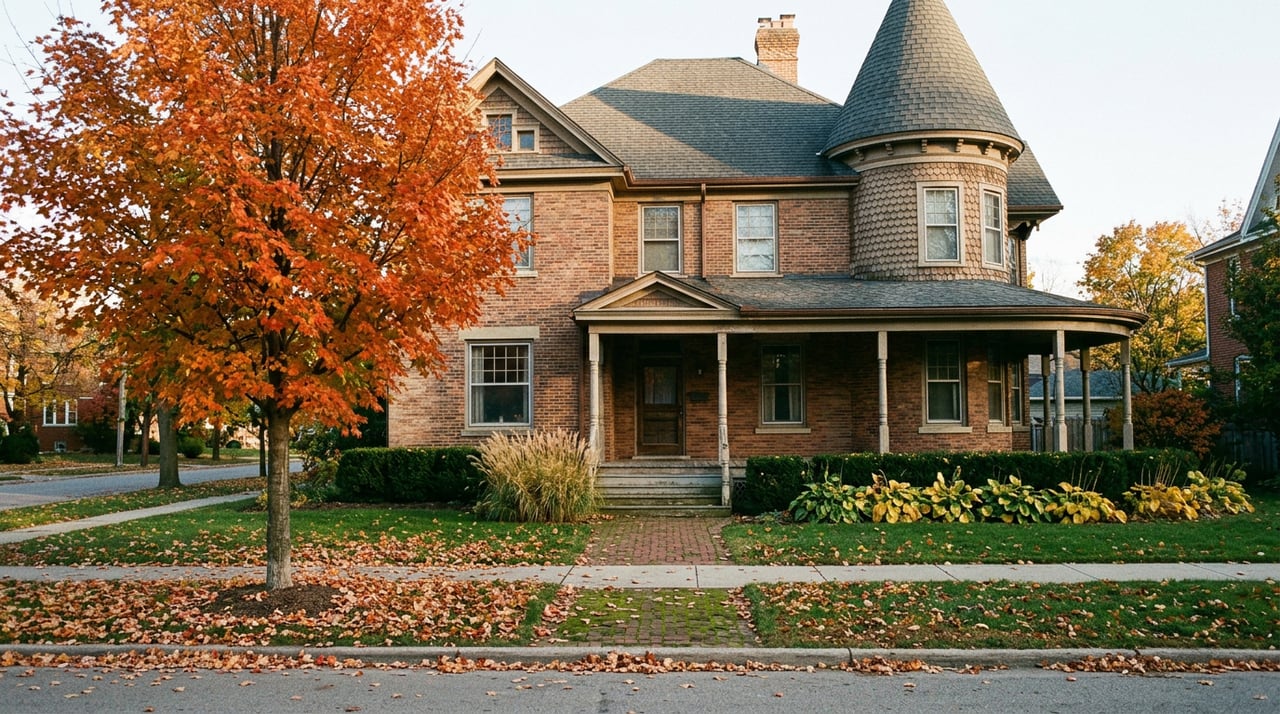
Waldo's larger footprint means more housing stock changes hands in any given month. Brookside doesn't have that option. The neighborhood is largely built out, its housing stock dominated by Tudor, Craftsman and Colonial homes from the early 20th century, which leaves little room for new single-family construction to smooth out the sales numbers over time.
One of the few parcels that could add meaningful new supply sits on Westover, where a former Kansas City Public Schools elementary building has stood vacant for years. The district floated a proposal to convert it into teacher housing, and the community pushed back. KCPS has since discussed other options for new single-family homes on the site, constrained by deed restrictions that limit its use to school purposes or single-family housing. Whatever happens there, it will not change Brookside's transaction volume enough to make its median behave like Waldo's. A handful of new homes on one lot doesn't offset a market where twelve or fewer sales a month is normal.
A single month's reported median tells you less than it looks like it does, and it tells you a different kind of less depending on which neighborhood you're reading. In Brookside, ask how many homes actually closed to produce that number before treating a swing as a market signal. A neighborhood that sold two or three homes last month can post a double-digit percentage move that has nothing to do with what your own offer would need to be.
In Waldo, the larger sample means the published number tracks real demand more closely, but the wide range underneath it still matters. A $359,999 median sits between a decades-old bungalow south of 78th Street needing updates and a new build on Main Street. A Tudor-style home in the Rockhill Gardens subdivision, which sits near the Waldo shops and Bier Station, recently listed at $315,000, a data point that lands close to the median but describes a very different house than either extreme. The number tells you the middle. It doesn't tell you which house you're actually comparing yourself to.
If you're weighing Brookside against Waldo on price, look at six to twelve months of closings instead of one, and ask what kind of home produced each number. That's the comparison that actually holds up once you check it against the next month's report.
Is Waldo cheaper than Brookside? On paper, yes, and by a wide margin most months. But Waldo's price range runs from a mid-five-figure fixer-upper to a $670,000 new build, and Brookside's typical entry point sits close to where Waldo's median ends. The honest comparison is the housing stock, not a single median.
Why does Brookside's median swing so much some months? Because the number is often built from as few as two or three closings. One high-end sale, or its absence, moves the reported figure more than any real shift in value would.
Does a big year-over-year swing mean the neighborhood is heating up or cooling off? Not by itself. Check how many homes actually closed that month before drawing a conclusion from the percentage.
If you're trying to figure out what a Brookside or Waldo budget actually buys, block by block, TribeKC Realty can walk you through the last several months of closings on the streets you're actually considering, not just the headline number.
Stay up to date on the latest real estate trends.


We pride ourselves in providing personalized solutions that bring our clients closer to their dream properties and enhance their long-term wealth.